Welcome to my personal website!



Historical Gaslighting: Usman bin Yahya and the Politics of Colonial Knowledge – A Brief Review of Professor Azyumardi Azra’s Book Chapter
Roqiyul Syam
4/19/20266 min read
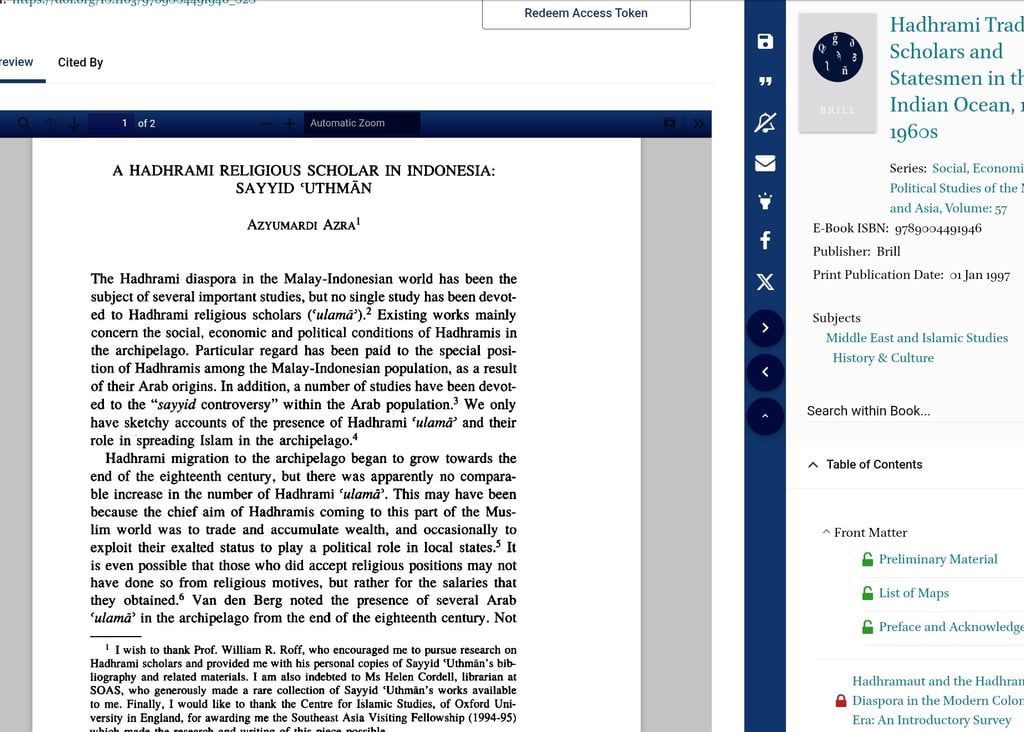
In the canon of Indonesian Islamic history, Usman bin Yahya occupies a deeply contentious position. As the Mufti of Batavia, heavily relied upon by the Dutch colonial government, he was not merely a cleric but a political actor playing a crucial role in "policing" Muslim public opinion amidst the vertical and horizontal social fragmentation orchestrated by the Dutch East Indies Company. Through the book chapter written by the late Professor Azyumardi Azra, titled "A Hadrami Religious Scholar in Indonesia: Sayyid Uthman" (in Hadhrami Traders, Scholars and Statesmen in the Indian Ocean), we are invited to look beyond his formal image. We discover that Usman bin Yahya’s authority was not built solely on pure scholarship, but on the construction of manipulative power. This review is grounded in a fluid question: Was Usman bin Yahya fundamentally ignorant of history, or was he intentionally "misunderstanding" it to accommodate colonial interests?
The Mufti vs. The Sufi Rebels of the Archipelago: between the Obscure and the Evident
One of Usman bin Yahya’s most glaring epistemological errors concerns his position on the history of Islam in the archipelago. He repeatedly constructed a narrative that no scholars—neither Arab nor indigenous—had ever advocated for jihad against colonizers, nor for the practice of tasawuf (Sufism) or tarekat (Sufi orders) in the region. For him, resistance against the colonial government was ghurur (delusion), and Sufi practices were anomalies deviating from orthodoxy.
Azra dismantles this with a powerful counter-argument: the Islamization of the archipelago was, in fact, driven by Sufistic currents that emboldened local rulers and sultanates to resist colonial rule. Usman bin Yahya’s attempt to deny the role of Sufism is a form of "gaslighting" or "historical amnesia" that was, in all likelihood, deliberate. Even roughly a century later, Rizieq Shihab propagated the notion that it was only the habib (descendants of the Prophet) who brought Islam to the archipelago while the indigenous population was still worshipping trees—a misleading and historically illiterate claim.
In this context, L.W.C. van den Berg’s observation is highly relevant: the more learned or educated an indigenous scholar became, the more they distanced themselves from the Hadrami "Sayyid" community. This phenomenon reveals that the exclusive narrative promoted by Usman bin Yahya created alienation. Enlightened indigenous scholars began to realize that the claims of "purity" promoted by certain Hadrami groups were often a means to perpetuate class domination, causing them to lose their moral authority in the eyes of local scholars.
To establish discursive dominance, Usman bin Yahya employed two primary strategies designed to silence his ideological opponents. First, he leveraged his personal legitimacy rooted in his claim of being a descendant of the Prophet. In traditional Muslim society, this genealogical status is not trivial; it carries a charismatic moral authority that demands respect and often unquestioning obedience. By positioning himself as the one "most entitled" to speak on religious matters due to his lineage, he attempted to isolate indigenous scholars who lacked such symbolic capital.
However, genealogical capital was insufficient for the intellectual dynamics of the archipelago. Thus, his second strategy involved utilizing a heavy external legitimacy: invoking the name of the great Nusantara scholar residing in Mecca, Sheikh Nawawi al-Bantani. This culminated in his written work, An-Nashihah al-'Aniqah li al-Mutalabbisin bi at-Thariqah (The Elegant Advice for Those Involved in the Tarekat).
In this work, Usman bin Yahya launched sharp criticisms against the Sufi orders (tarekat) flourishing in the Dutch East Indies, labeling them as deviant and innovative (bid'ah). To validate his stance, he propagated the narrative that his work had received the blessing or positive commentary of Sheikh Nawawi al-Bantani. By "name-dropping" Nawawi, he hoped his criticisms would be accepted as unquestionable "authoritative truth." This was a subtle yet dangerous form of intellectual manipulation, attempting to lock the discourse by pitting his opponents against a figure deeply revered by the entire Muslim community in the archipelago.
Beneath these claims of support lies a significant "black hole." To what extent was there a genuine connection between Usman bin Yahya and Nawawi al-Bantani regarding this critique of the tarekat? Azra highlights significant uncertainty here. There is no conclusive evidence that Nawawi al-Bantani supported Usman bin Yahya’s specific agenda to eradicate tarekat in the archipelago. On the contrary, Nawawi was known for his broad and profound Islamic perspective. Linking Nawawi’s great name to Usman’s sharp criticism appears to be a forced attempt to legitimize the Mufti's political position rather than a reflection of honest theological consensus. Indigenous scholars began to realize that Usman bin Yahya's position was, in many respects, aligned with the wishes and goals of the colonial government. They saw that his rhetoric of "purifying religion"—through An-Nashihah al-'Aniqah—was not an effort to improve the moral character of the ummah, but rather an attempt to fragment the community's strength to prevent them from uniting against colonialism.
What is clear from historical records is the utter futility of Usman bin Yahya's efforts. The writings he produced, the genealogical claims he glorified, and the false support he constructed failed entirely to silence resistance. The people—farmers, rural kyai, and practitioners of tarekat—could not be steered by fatwas that smelled of colonial influence. While they did not entirely succeed in expelling Dutch colonial power, uprisings led by these peasants and Sufis continued to erupt across various regions. It is essential to remember that it was precisely the resistance of these indigenous Muslim elements that kept the flame of defiance burning until Indonesia achieved its independence. In the context of Sufi practices at the time, tarekat practitioners remained steadfast on their spiritual path because, for them, the tarekat was a source of inner strength to endure oppression, not merely the bid'ah alleged by the Mufti.
Assessing Usman bin Yahya’s Integrity: an Intellectual or a Servant of Colonial?
Usman bin Yahya's case offers a valuable lesson for us all regarding the integrity of a scholar or cleric. We must be brave enough to ask: where is the line between serving the truth and serving self-interest? History records that a person, despite high erudition, can intentionally "cover the truth" for the sake of personal, clan, or factional interests, or to please the "masters" who sustain them.
When an intellectual chooses to become a tool of power, they lose not only their integrity but also their sensitivity to the suffering of the people they should be defending. Usman bin Yahya may have thought he was performing islah (reform) through his writings, but he was blind to the fact that his work had become an instrument of oppression. He was more concerned with the stability of the colonial system—which provided him with a monthly salary in Guilders and a formal religious position—than with understanding the pulse of the spiritual society he led. This serves as a reminder to anyone holding intellectual authority today: is our knowledge used to enlighten, or is it used to "lock" the truth to maintain our status quo and comfort before power?
Ultimately, Azyumardi Azra's critique of Usman bin Yahya reveals that the errors committed by the Mufti of Batavia were not mere misinterpretations of texts or historical ignorance. This was an epistemological construction aimed at "policing" Islam to make it "obedient" and "predictable" within the colonial administrative framework. Through his book, he attempted to redefine Indonesian Islam into a form more suited to Dutch interests—an Islam that was legalistic, obedient to authority, and stripped of the spiritual passion and resistance often emerging from tarekat networks.
Yet, history proves that his efforts to separate tasawuf from syariat and to erase the historical role of Sufism in Indonesian Islam were in vain. Islam in the archipelago continued to grow with strong Sufi roots, which made it resilient, flexible, and intellectually profound, transcending the narrow mold that a Mufti, who sadly failed to understand the inner dynamics of the society he should have led, sought to impose. Unsurprisingly, Azra documented the massive criticism from Sufi tarekat leaders directed at the colonial Mufti, regarding him as someone envious of others' influence. Indeed, the Muslim community in the archipelago increasingly ignored him.
Admittedly, in terms of productivity, the Mufti of Batavia was a prolific writer. It is in the spirit of acknowledging this contribution that Azra’s book chapter was written. However, Azra’s discussion—highlighting the errors in historical narrative that served as the basis for his "heretical fatwas" against the tarekat, particularly the Naqsyabandiyah whom he despised—serves as a reminder to us all, especially in today's academic and social context, that historical data and facts must not be sacrificed for the sake of political agendas, regardless of the position held by the narrator. Usman bin Yahya may have been a productive scholar, but in his efforts to serve colonial interests, he lost the critical perspective and deconstruction of all power idols other than Allah, which is, in fact, one of the essences of the Islamic scholarly tradition itself.